


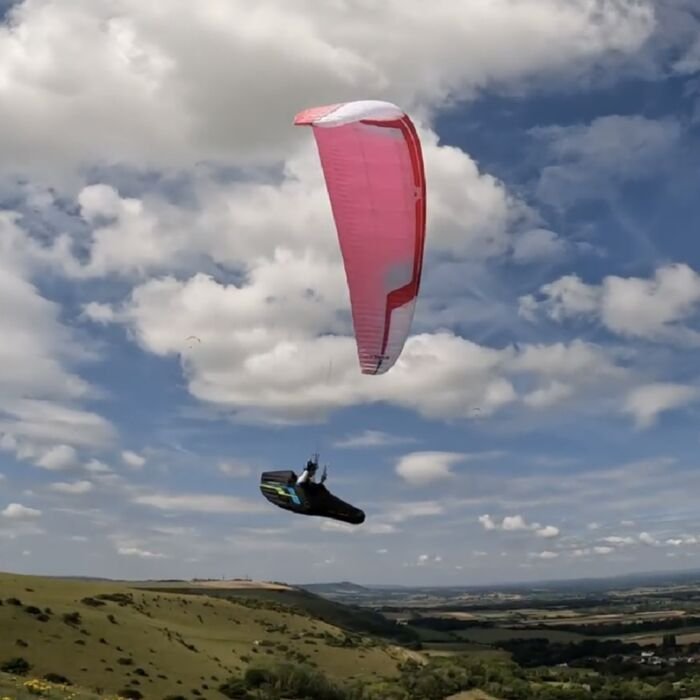




Niviuk Artik R 2 (general info)
Technical data
| Size | 20 | 21 | 23 | 24 | 25 | 27 |
|---|---|---|---|---|---|---|
| Total Weight in Flight (kg) | 60-75 | 70-85 | 80-95 | 90-105 | 100-115 | 110-125 |
| Optimal Weight in Flight (kg) | 65-70 | 75-80 | 85-90 | 95-100 | 105-110 | 115-120 |
| Area Flat (m²) | 19.6 | 21 | 22.5 | 24 | 25.5 | 27 |
| Area Projected (m²) | 16.76 | 17.97 | 19.26 | 20.54 | 21.83 | 23.11 |
| Glider Weight (kg) | 4.0 | 4.2 | 4.5 | 4.8 | 4.9 | 5.4 |
| Aspect Ratio Flat | 6.5 | 6.5 | 6.5 | 6.5 | 6.5 | 6.5 |
| Aspect Ratio Projected | 5.02 | 5.02 | 5.02 | 5.02 | 5.02 | 5.02 |
| Span Flat (m) | 11.29 | 11.68 | 12.10 | 12.49 | 12.87 | 13.25 |
| Cells Number | 68 | 68 | 68 | 68 | 68 | 68 |
| Chord Maximum (m) | 2.19 | 2.26 | 2.34 | 2.42 | 2.49 | 2.57 |
| Lines Total (m) | 183 | 190 | 197 | 203 | 210 | 216 |
| Lines Main | 2-2/3 | 2-2/3 | 2-2/3 | 2-2/3 | 2-2/3 | 2-2/3 |
| Risers Number | A-A’/B | A-A’/B | A-A’/B | A/A’/B | A/A’/B | A/A’/B |
| Speed-Bar Travel (mm) | 160 | 160 | 160 | 160 | 160 | 160 |
| Certification | EN C | EN C | EN C | EN C | EN C | EN C |
The total weight of the wing may differ ±2% due to variations in the weight of the fabric supplied by the manufacturers.
Colours
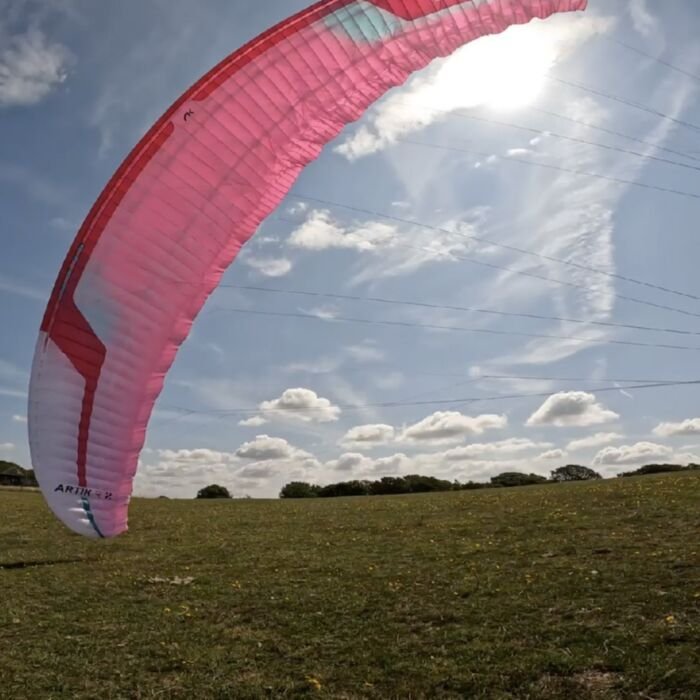
Standard colours: Neon, Glacier, Quetzal.

Custom colours: Choose your colours and email us the colour reference with your order. Include a screenshot if you can. Full payment required upfront to confirm your order after which it cannot be cancelled.
Package
- Wing
- Ergo Handles
- ZipNkare bag
- Repair Kit
Optional extras (Related Products)
- Kargo Backpack 130L (Recommended size for sizes 20,21 and 23)
- Kargo Backpack 180L (Recommended size for sizes 24,25 and 27)
- Paragliding Backpacks
- Concertina Packing Bags
- Harnesses
- Reserves
- Helmets
- Instruments

Niviuk Artik R 2: THE TWO-LINER REVOLUTION
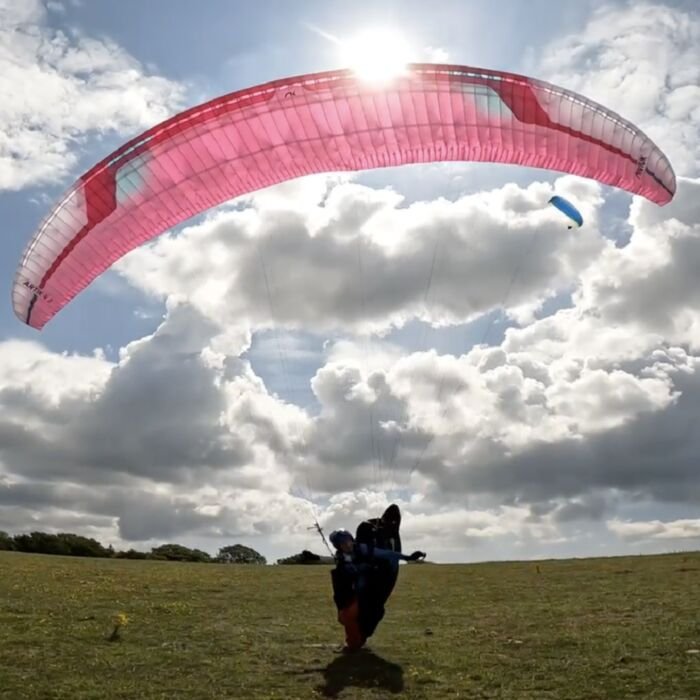
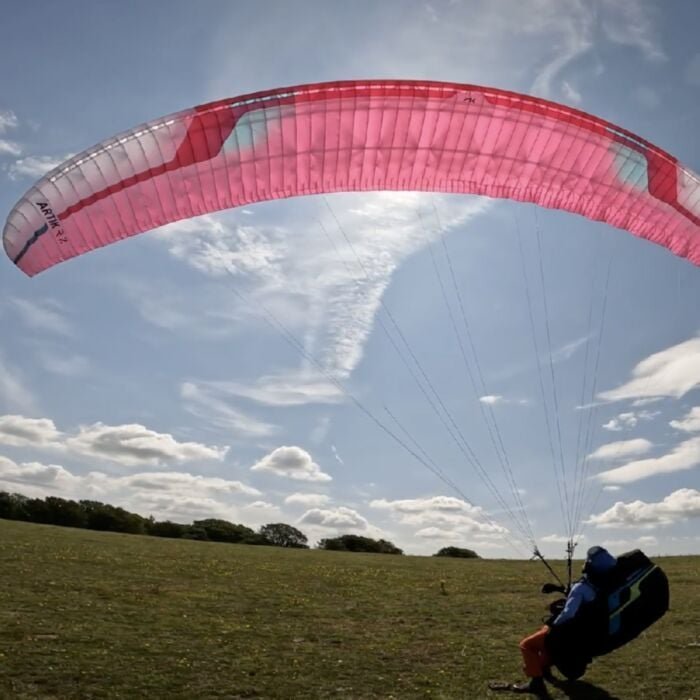
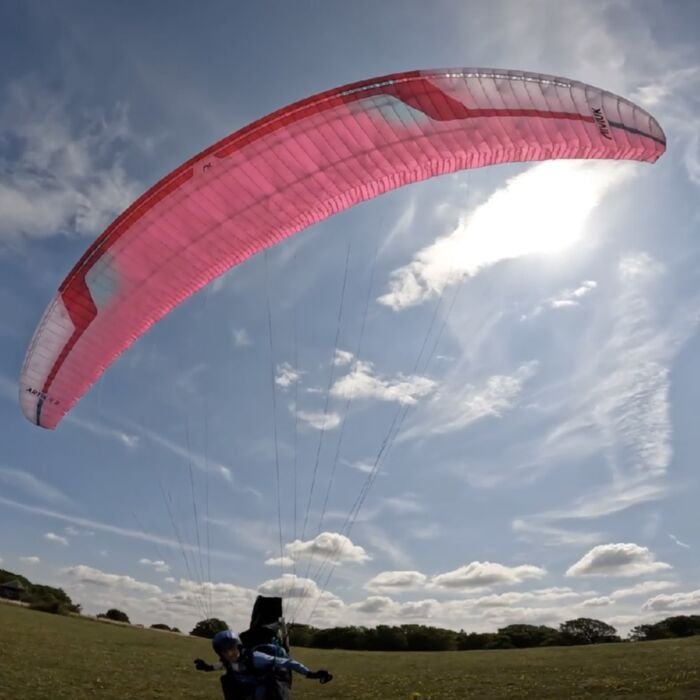
The Artik R 2 is the most accessible two-liner in our range. It allows you to enjoy performance very close to that of competition wings. It is the result of Niviuk’s extensive knowledge of two-liner wing design, offering an unparalleled level of performance without sacrificing comfort in flight.
Target
Cross-country
Niviuk developed numerous prototypes to achieve a high level of performance that is accessible and comfortable in real flying conditions. Explore new horizons with the Artik R 2.
Competition
The new profile is more stable than the previous model. Its internal structure has been completely redesigned. The Artik R 2 stands out for its efficiency in thermals and its stability at high speed, making it ideal for your first steps in competition.
Pilot review
“The Artik R2 launches effortlessly, handles precisely in thermals, and gives constant feedback through the tips. It feels pressurized and safe, becomes very stable at speed, and flies with high performance and control. With X-One technology clearly at work, it stands out as a top-level wing for both competition and distance flying.”
– MANUEL GRANDI, PILOT-ITALY
“The Artik R2 evolves the EN-C 2-liner concept to its performance/safety peak—benefits that carry across our range.”
– ADRIÀ GRAU, MECHANICAL ENGINEER, R&D TEAM
Features
Less drag, more performance
The two-liner design reduces the number of lines and therefore drag, thus improving performance. We have been able to reduce the lineset by 2%, despite the addition of 4 more cells, compared to the previous model.
Optimised accessibility
Much more accessible and easier to fly. The Artik R 2 is light and responsive in thermals. Piloting with the B-risers is efficient, safe and precise.
Better passive safety
Thanks to improvements in stability, a moderate 6.5 aspect ratio and Niviuk technologies applied in its design, the Artik R 2 offers increased passive safety.
Comparative chart of the Artik R 2 vs Artik R

Niviuk technologies
New profile
The design of the new profile is much more pitch stable than its predecessor: the wing dampens efficiently and cuts through the air mass without losing energy.
Reinforced internal structure
The internal structure has been completely redesigned and the attachment points reinforced to ensure optimal stability. The orientation of the internal slots, ribs and diagonals has been revised to better distribute the loads and reduce the overall weight of the glider.
Improved DRS integration
Thanks to DRS technology, the mini-ribs are integrated directly into the seams, eliminating external seams and protecting the wing from wear due to friction with the ground.
Structured leading edge
Nitinol rods in the leading edge make up the SLE. This technology provides greater solidity and stability to maintain its shape in all phases of flight. This increases performance, efficiency and stability, absorbs turbulence better and makes the wing much more durable over time.
3D Leading Edge
3DL technology is an adjustment of the fabric at the leading edge of the wing to control the ballooning and the creases that are generated by the curvature in this area. The leading edge is then divided into sub-panels which are sewn into each of the cells at the front of the paraglider. As a result, the leading edge of the wing is perfectly tensioned, which benefits the wing in performance and durability.
A good comparison is a rugby ball. In order to produce its characteristic oval shape without creases, its cover is made of several panels – not of just one piece.
The application of this innovation, in conjunction with the 3DP, is key to converting the perfect shape from 2D to 3D.
RAM Air Intake
The RAM Air Intake system is based on the inward orientation of the air inlets in the profile so that they allow an optimum internal pressure at all angles of attack.
The result? Having greater internal pressure means better buffering of turbulence, greater consistency of the profile shape across the speed range. Excellent handling at low speed is achieved by allowing the pilot to extend the braking limit, so there is a lower risk of collapse and consequently, greater control and stability.
Radial Sliced Diagonal
RSD (Radial Sliced Diagonal) technology is a reinvention of the wing’s internal structure. It incorporates independent and efficiently oriented diagonal ribs, which follow the direction of the cloth. This improves the strength, reduces weight and minimises deformation.
These days, in order to improve stress distribution and reduce the number of attachment points and lines, most wings have these diagonal ribs, which are connected from the attachment points to the adjacent profiles.
In conventional diagonal ribs, loading and unloading cycles away from the highest strength axis of the cloth result in a loss of shape, which reduces the cohesion of the wing and therefore aerodynamic efficiency.
3D Pattern Cut Optimization
This technology seeks to implement the best orientation of the cloth on each panel according to its location on the leading edge. If the cloth pattern is correctly aligned with the load axes, the cloth suffers less deformation flight after flight, so the leading edge maintains its shape better and remains stronger over time.
The design of our paraglider and paramotor wings has evolved a lot over the years, with a positive and specific focus on the leading edge.
Thanks to this technology and 3DL, a perfect modelling of the panels and an exact representation from 2D to 3D is achieved.
Drag Reduction Structure
The DRS aims to reduce drag and the adverse pressure gradient by optimising the aerodynamic shape of the wing. With its application, the direction of airflow is much more progressive at the trailing edge. This increases performance without compromising safety or handling.
Structured Trailing Edge
Nitinol rods at the trailing edge form the STE. Thanks to this technology, it maintains its shape in accelerated flight. The rigidity provided by these elements improves the load distribution, reducing creases, and consequently drag, and therefore ensuring better performance.
Titanium Technology
Nitinol is a combination of 50% nickel and 50% titanium. The incorporation of Nitinol rods in the profile increases the performance of the wing, especially in three areas:
– Compared to nylon rods, the weight of the wing is reduced by 13%.
– Nitinol has two essential characteristics: shape memory and enormous elasticity. As a result, the rods retain their optimum shape even after an ultra-compact or incorrect folding, so that the wing is not deformed. This will always be the case unless the radius at the point of curvature is less than 1 cm.
– The leading edge shape is much more rigid and uniform which results in a much more consistent and progressive inflation and therefore an easier take off. The profile is taut at all times, without creases, and fully optimised for all flight phases.
In addition, the rods have a plastic protector at their ends to prevent any damage to the fabric of the wing.
Nitinol is now featured in all our wings.
Learn more about Niviuk Paraglider Technologies


Reviews
There are no reviews yet.