






Technical data
| Size | XS | S | M |
|---|---|---|---|
| CTW¹ (kg) | 70-95 | 80-105 | 90-115 |
| RTW² (kg) | 80-90 | 90-100 | 100-110 |
| Flat area (m²) | 23.36 | 25.69 | 27.99 |
| Projected area (m²) | 19.8 | 21.77 | 23.72 |
| Flat aspect ratio | 5.5 | 5.5 | 5.5 |
| Projected aspect ratio | 4.18 | 4.18 | 4.18 |
| Weight (kg) | 5.1 | 5.3 | 5.6 |
| Number of cells | 66 | 66 | 66 |
| Flat span (m) | 11.34 | 11.89 | 12.41 |
| Projected span (m) | 9.1 | 9.54 | 9.96 |
| Line diameter (mm) | 0.4 / 0.5 / 0.7 / 0.8 / 0.9 / 0.95 / 1.2 | ||
| Line length (m) | 6.81 | 7.14 | 7.45 |
| Max. chord (m) | 2.60 | 2.72 | 2.84 |
| Certification (EN/LTF) | B | B | B |
¹ CTW: Certified take-off weight in kilograms.
² RTW: Recommended take-off weight in kilograms.
Sizes XXS and L are available for the MENTOR 7 Light.
Colours
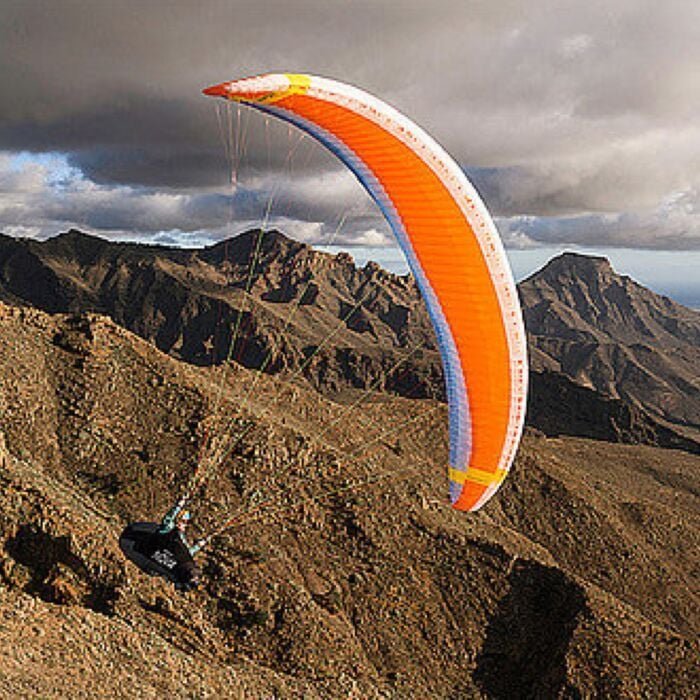
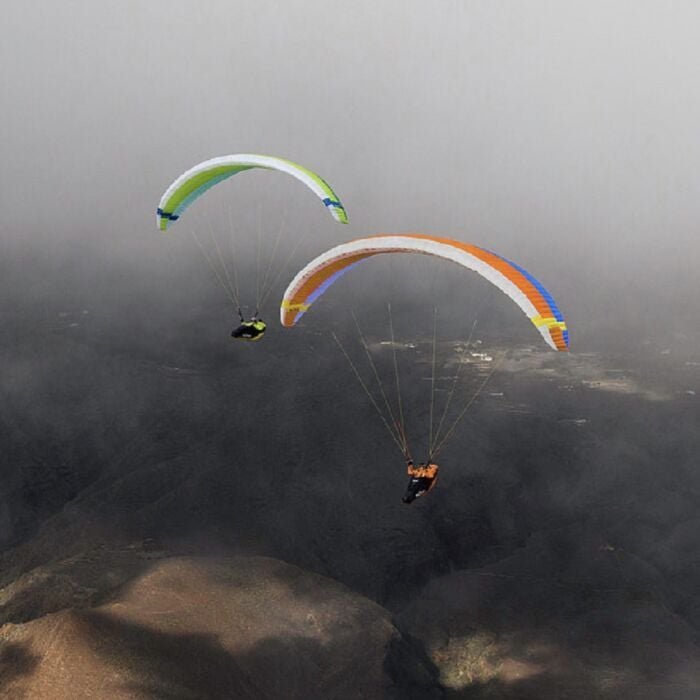
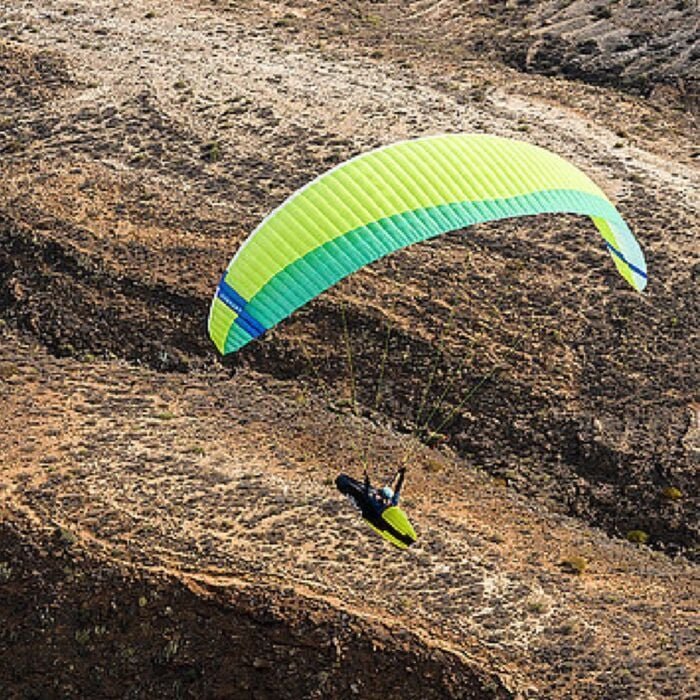
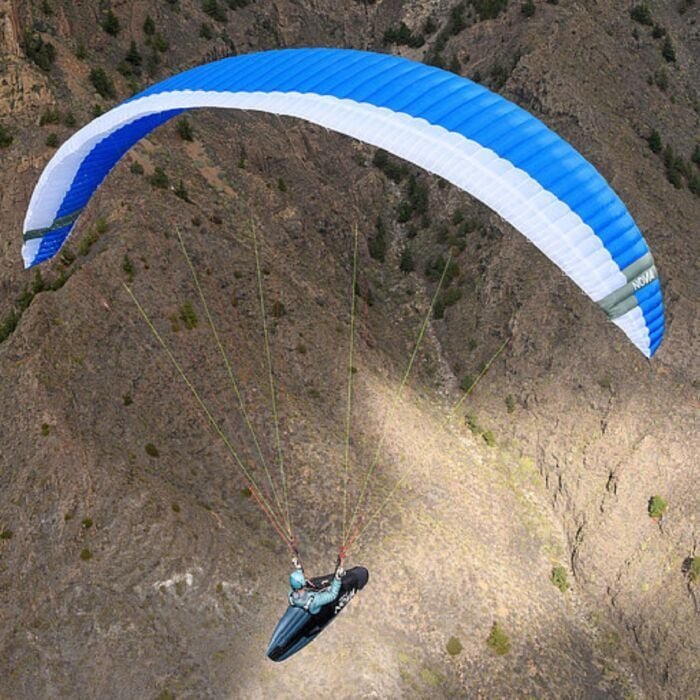
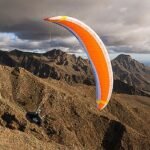
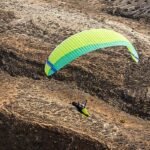
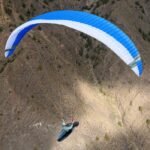
Standard colours: Blue, Lime, Orange.
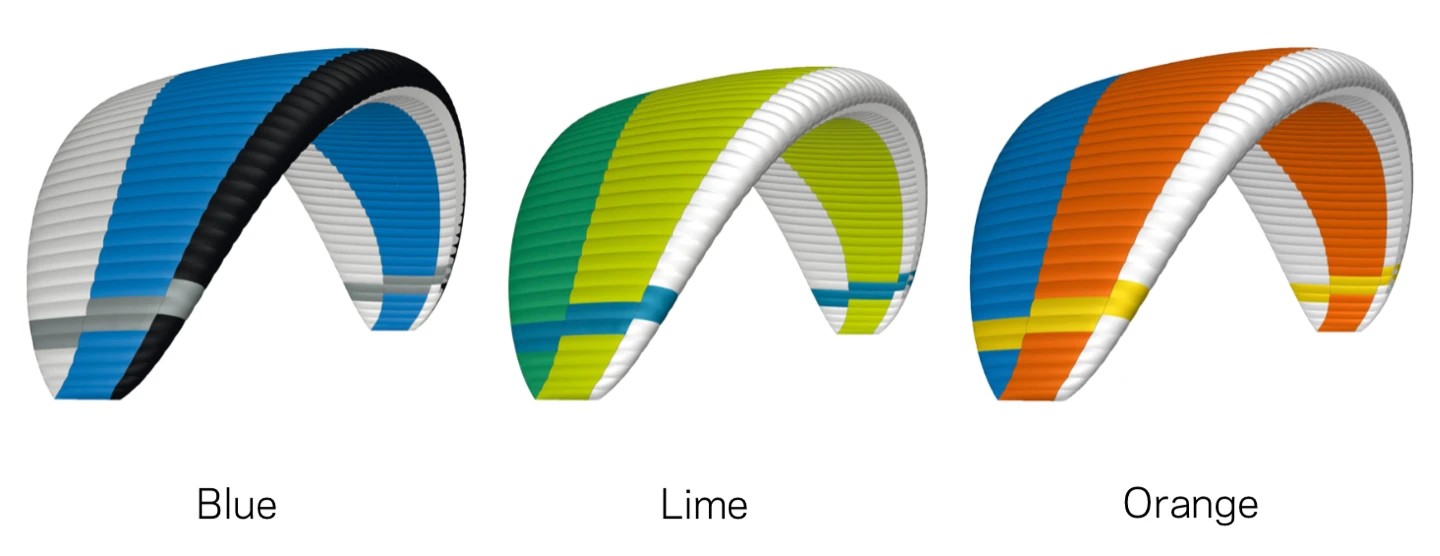
Custom colours: Choose your colours and email us the colour reference with your order. Include a screenshot if you can. Full payment required upfront to confirm your order after which it cannot be cancelled.
Package
- Concertina Bag Light
- Inflatable pack roll
- Manual
- Windsock
- Repair kit
- Speed system cords
Optional extras
- Nova Backpack
MENTOR 7 – The XC machine
Efficient en route. The 2.5-liner design of the MENTOR 7 combines performance and comfort in a unique way. Philipp Medicus, Head of R&D at NOVA explains: “The difference in design between the MENTOR 6 and 7 is greater than between the 2 and the 6. Through this innovative approach, the performance has drastically increased, without raising the demands on the pilot. The result is a cross-country paraglider that allows you to go big distances safely and efficiently.”
Designed for XC. The MENTOR 7 was built for cross-country flying. Fully accelerated, it cuts solidly through turbulent air masses, and the C-riser-control can be used to efficiently mitigate turbulence. The safe and calm feeling when flying allows the pilot to stay focused and concentrate on tactical decisions – even on long flights. Despite its high stability, if the MENTOR 7 has a collapse, the reaction is manageable even at top speed. All NOVA test pilots confirm that this wing, with its moderate aspect ratio of 5.5, is very pleasant to fly and additionally has even more top speed than the MENTOR 6. The ideal prerequisites for new XC records.
Pitch control like a 2-liner. For optimal ergonomics, the risers of the MENTOR 7 are equipped with height adjustable C-handles (HAC-Handles). The C-handles allow pitch control during accelerated flight, which was previously reserved for two-liners like NOVA XENON. This means it is easy to compensate for turbulence and flying XC is far more efficient. Those with no previous experience of C-riser-control can take a relaxed approach to learning this new flight technology with the MENTOR 7 and gain a real performance advantage for themselves. Please note: how this C-riser-control works is explained in the FAQ below.
Elaborate design. In addition to the 2.5-liner concept, the MENTOR 7 is characterised by a complex inner life, 66 cells and additional rods in the rear are of the wing. These design features play a vital role in the outstanding performance of the paraglider. NOVA has cast aside their Easy Packing concept in favour of the clear performance advantage. To protect the rods, the MENTOR 7 should be packed using a Pack Roll, or wrapped around the harness, in a cell pack sack such as their Concertina Bag Light.
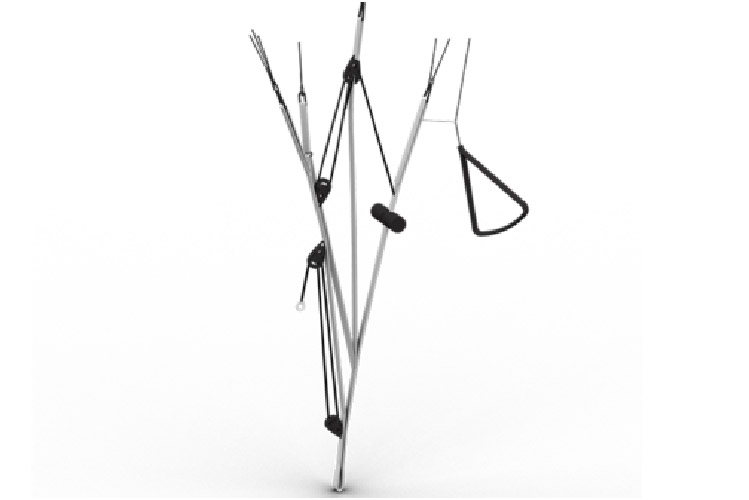
The risers in practice. The most prominent feature on the MENTOR 7’s new Speedbrake Riser 2.0 are the HAC-Handles. Another striking feature is the “Baby-B” line, which acts as a moveable pulley on the B3 line. This means the riser is a little more complex, but it is still clearly laid out and easy to handle even when launching. Good to know when ground handling: you can kill the MENTOR 7 very efficiently using the C-lines. As there is no C3 line, what does not work so well are asymmetric corrections via the C-lines. For lateral directional corrections, they therefore recommend using the brake. Please note: for more clarity during pre-flight preparation, a magnet holds the A and Baby-B risers together. For optimum launch behaviour, they recommend releasing the magnet and only holding the A-riser.
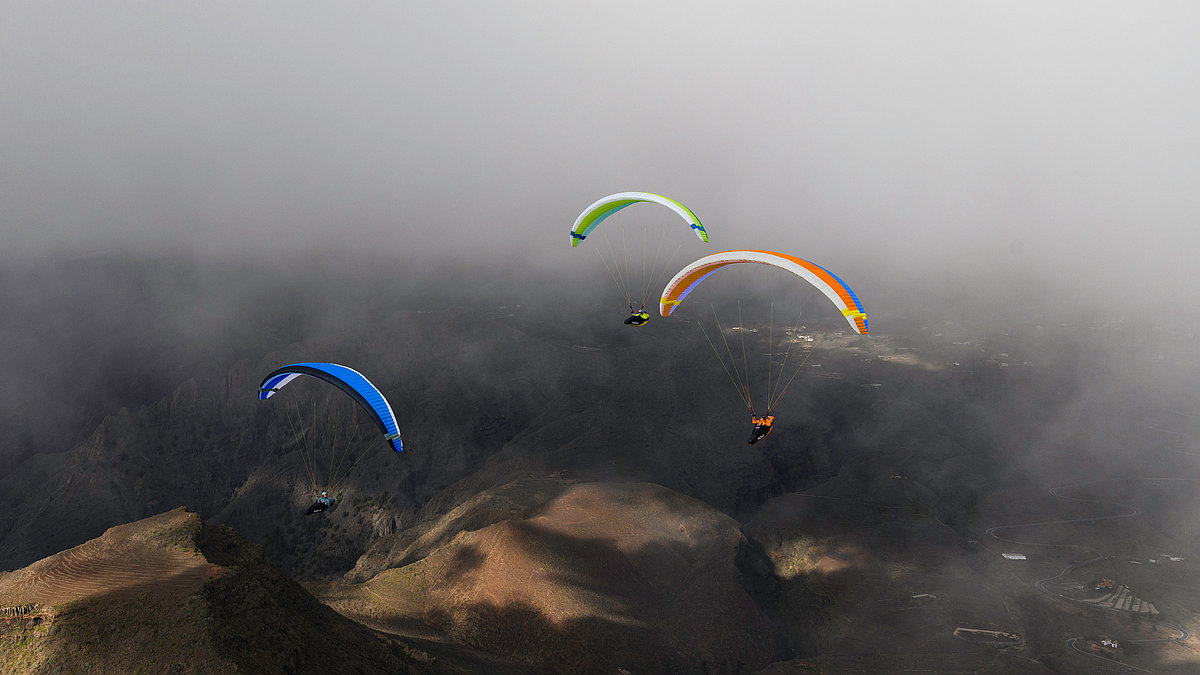
Pilot target group
The MENTOR 7 (EN/LTF B) is a state-of-the-art “teacher” in the tradition of the MENTOR series (performance, smooth in flight, safety). It does not tend to overshoot during inflation and impresses with an extreme flight behaviour that is manageable for its class. The hybrid 2.5-liner is suitable for cross-country pilots who are experienced in handling EN B gliders, or who want to get the maximum out of a flight using the speed-bar and HAC handles. Anyone wishing to familiarise themselves with pitch control similar to the flying feeling of a two-liner, this is the wing to fly. It is important to understand that the hybrid construction partly influences ground handling and means, for example, that the use of the B3 stall is more efficient than classic big ears.
New features
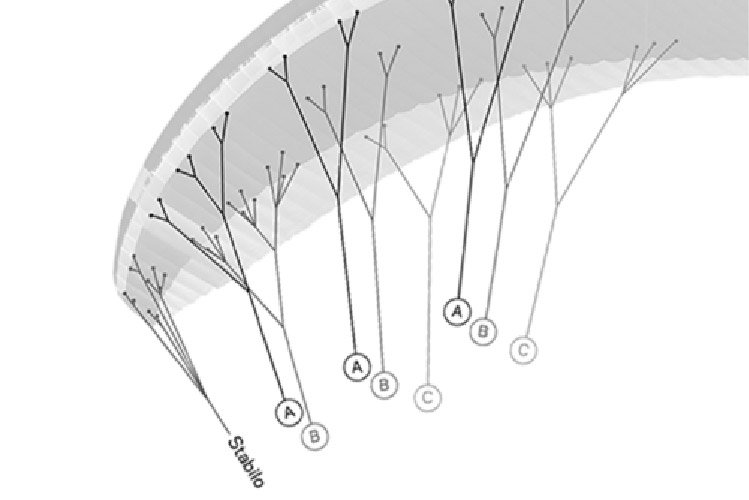
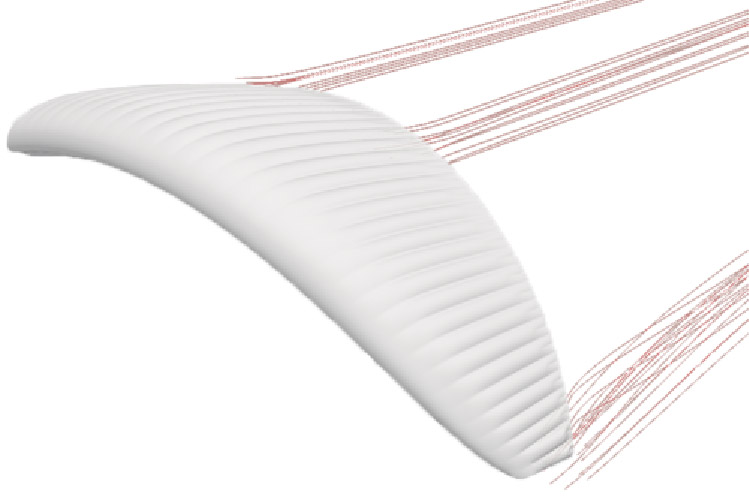
Hybrid design as a 2.5-liner. On the outer wing the MENTOR 7 is a two-liner, in the center a three-liner. This means this “2.5-liner” does not have a C3 line. The smart redistribution of the attachment points and a profile optimised for accelerated flying make the MENTOR 7 a comfortable and potentially record-breaking fast cross-country glider. At the same time, the safety and smoothness in flight remains typical of the MENTOR and accordingly the certification also resulted in EN B certification.
Speedbrake Riser 2.0 incl. HAC Handles. The MENTOR 7 has HAC handles (Height Adjustable C-Handles) on the newly revised riser. With these, pitch movements in accelerated flight can be compensated for in the best possible way. This means that on cross-country flights you to get from A to B even more efficiently – i.e. faster and with less sink. In addition, the C-riser-control is very comfortable and requires little effort.
Aerodynamics optimised for speed. The design of the MENTOR 7 focused on speed. The profile ensures a high degree of pitch stability even at low angles of attack. In numerous simulations, the ballooning as well as the stress distribution was refined to minimise the deformation of the glider when accelerated. The cell openings are designed so that the internal pressure remains ideal even in accelerated flight. The result is excellent glide performance with an exceptional level of stability.
Technology
Two concepts combined
A 2-liner at the wing tips, a 3-liner in the centre. This means this “2.5-liner” does not have a C3-line. Reduced line metres means less drag. Thanks to the two line areas at the wing tip, during acceleration an aerodynamically favourable wing twist is possible. This increases the performance in accelerated flight. The design also enables particularly efficient C-steering.
Flat profile nose
Anyone who tries to fold a piece of paper around a ball will notice that there are always creases. The nose profile of a paraglider is the same – the sail cloth has to adjust to both the profile and ballooning effect (cells are round, not straight). Double 3D Shaping uses additional seams to reduce creasing and therefore increases the performance of the wing.
Under pressure
NOVA Air Scoop is an optimised air intake, which increases the internal wing pressure. NOVA’s Air Scoop principle is similar to the ram-air inlet duct on a sports car: increased airflow produces higher pressure. Higher internal pressure in a paraglider means improved performance through increased structural stability and collapse resistance.
More compact
The aspect ratio of a glider is not the only factor in passive safety, but still a very important one. A high aspect ratio favours cravats after asymmetric collapses, generally shortens brake travel and normally makes wings more difficult to fly. Nova’s analytical tools permit them to build performance wings even with a low or moderate aspect ratio.
Materials
| Leading edge: | Skytex 38 Universal, 38 g/m² |
|---|---|
| Top surface: | Skytex 38 Universal 38g/m², Skytex 40 Eazyfly 40g/m² |
| Lower surface: | Skytex 40 Eazyfly 40g/m² |
| Profile ribs (suspended): | Porcher Skytex 40 Hard, 40 g/m² |
| Profile ribs (unsuspended): | Porcher Skytex 40 Hard, 40 g/m² |
Lines
| Main lines: | Liros PPSL191 / Edelrid U-8001-130 |
|---|---|
| Gallery lines: | Edelrid U-8000 / DC40 |
| Brake lines: | Edelrid 7850-240 / Edelrid U-8000 / Liros DC40 |
| Risers: | Kevlar 12 mm |

FAQ
How does the C-steering work?
The so-called HAC handles (Height Adjustable C-Handles) are mounted on the C-risers. These permit a more efficient pitch control, usually only possible on two-liners. The effort required to apply them is so minimal, that even after a long flight they never cause fatigue. In accelerated flight, the HAC handles can be used to increase the angle of attack more quickly and sensitively than would be possible by releasing the speed bar. Additionally, asymmetrical corrections are possible, e.g. for a change of direction. In the end, the C-steering means it is possible to fly faster, more efficiently and in a more relaxed manner. At trim speed, if the HAC handles are pulled down about 20 cm, a stall occurs, but the pilot will know this in advance through pulsating feedback on the handles. Well before the stall, performance is noticeably reduced. It is therefore not advisable to permanently slow down the MENTOR 7 below trim speed.
Do I have to use the C-riser-control?
No. You can even remove the HAC-Handles. The C-steering is an additional option to compensate for pitching movements of the glider – especially in accelerated flight. When used correctly, they ensure efficient flight in turbulent air.
How does the B3 stall work?
Instead of pulling down the outermost A-lines (like you do when applying big ears), the B3 lines are pulled down quickly and symmetrically about 40-50 cm to induce the B3 stall. As a result the outer wing folds to the rear. The brake handle remains in the hand without a wrap. The maneuver is stable and there is no flapping of the collapsed wing sections. The pressure to hold the B3 stall is minimal. To return to normal flight, release the B3 lines symmetrically. The wing will open without delay. If applying big ears, Nova recommends accelerating the wing at least 25%. By the way… as with big ears, the middle of the wing does not deform during the B3 stall. Therefore, the wing remains in forward flight.
Why do Nova recommend using the B3 stall instead of big ears for the MENTOR 7?
The B3 stall offers more stability with a higher sink rate. Classic big ears also work, but are less comfortable due to the non-split A-risers.
Is the MENTOR 7 more difficult to fly than the MENTOR 6?
No, the MENTOR 7 remains true to the principle of all paragliders in the MENTOR series, which means they are positioned at the top of the EN B class. The MENTOR 7 incorporates a great deal of design knowledge gained from the construction of the XENON (EN/LTF D) – but with the clear objective that the demands on the pilot are no higher than those of the MENTOR 6. The hybrid 2.5-liner design alone does not increase the demand; the reaction to collapses is even somewhat milder than before. The MENTOR 7 aspect ratio of 5.5, which is moderate in the high-end EN B classification, helps to ensure that the demands on the pilot are not too high. Please note: we recommend checking the manual to learn more about the typical characteristics of 2-liners (C-steering, ground handling, descent techniques).
How can I take full advantage of the speed-bar travel of the MENTOR 7?
The MENTOR 7 has a large speed-range and therefore long speed-bar travel. Depending on the size of the glider, and especially on the harness, it may not be possible to use the full speed-bar travel, as the Brummel hooks are “blocked” by the pulley of the harness before the full speed-bar travel is reached. There are several possibilities for optimisation: one option is to convert the speed system using speed-bar beads. The conversion kit (Speed System Cords) is included in the scope of delivery and instructions can be found in the manual. Alternatively, the harness can be attached without a Brummel hook by means of a clove hitch/lark’s foot or the harness and paraglider can be connected with a continuous cord. However, the latter will only work for pilots who do not disconnect their harness from their wing. If help is required during the conversion, you NOVA dealer will be happy to assist.
What is the best way to pack the MENTOR 7?
We recommend folding the MENTOR 7 cell to cell and then placing the NOVA Pack Roll in the crease near the leading edge. The idea behind the Pack Roll is that this crease will be less pronounced, which protects the rods. NOVA Concertina Bag Light is perfect for the job and facilitates a smaller packing volume.
What is the difference between “certified” and “recommended” weight range?
The certified weight range defines the legal limits of the take off weight. The ideal combination of climb, stability and speed for maximum XC efficiency can be found within the recommended weight range.
| size |
M ,S ,XS |
|---|---|
| color |
Blue ,Lime ,Orange |


Reviews
There are no reviews yet.